2023 ORSC
Accepted for permits through March 31, 2027.
- One additional measure from Table N1101.1(2).
- Seven measures to choose from.
- ERI climate zones 4C and 5C.
Pick your additional measures, run the UA trade-off, and print results that cite the Oregon section behind every number.
wsec.ai's Oregon tool works through Chapter 11, Energy Efficiency, of the Oregon Residential Specialty Code (ORSC), in both the 2023 and 2026 editions. Pick an edition, enter conditioned floor area, choose additional measures from the Oregon table, and run the UA trade-off. Each result names the section it comes from and links the Oregon Building Codes Division PDF page.
Code edition
Oregon is moving from the 2023 to the 2026 ORSC. Until March 31, 2027, a permit may use either one. The wizard runs both.
Accepted for permits through March 31, 2027.
In effect October 1, 2026. Required for permits from April 1, 2027.
How it works
Pick the 2023 or 2026 ORSC. For 2026, conditioned floor area sets how many additional measures you need.
Choose from the Oregon measures table. Combinations the table rules out cannot be selected.
Enter areas and assemblies. The wizard compares Proposed UA to Code UA and links the Oregon section for each value.
Additional measures
Every new dwelling adds measures on top of the base envelope. These are the options, read from the Oregon code text.
A new dwelling over 1,500 sq ft needs two additional measures. At 1,500 sq ft or less, one additional measure. From Table N1102.3(2).
Sample output
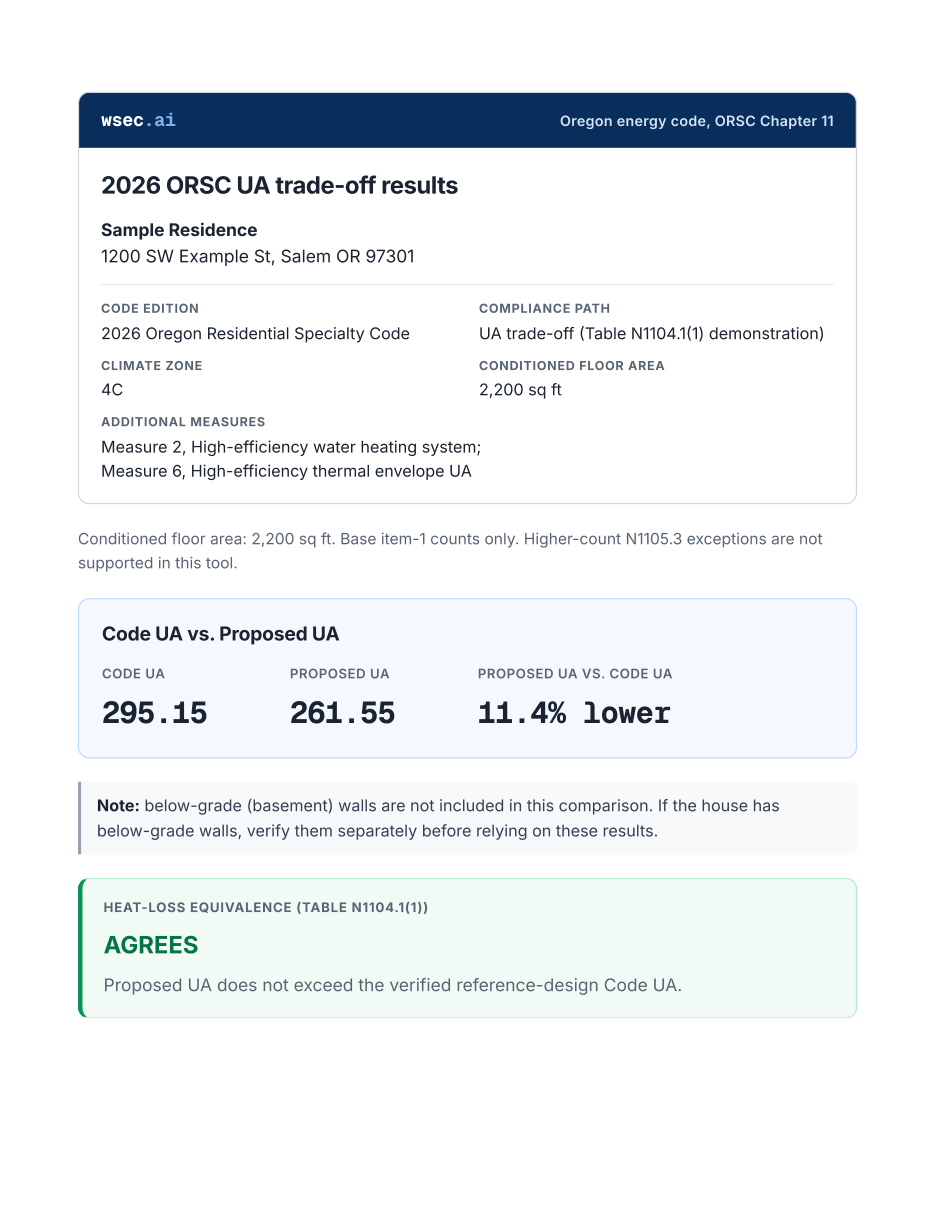
A 2026 ORSC run for a fictional 2,200 sq ft house in Salem with two additional measures. Every input, the Code UA and Proposed UA, and the Oregon section behind each number, on one printout.
Sample Residence is fictional. The printout is the wizard's own results page, printed from the browser.
Climate zones
Oregon's prescriptive envelope values are the same statewide. Climate zone matters in Chapter 11 in one place: the maximum Energy Rating Index for the ERI path. Each edition names its own zones.
2023 ORSC, Table NA1109.1
| Climate zone | Maximum ERI |
|---|---|
| Zone 4C | 54 |
| Zone 5C | 55 |
2026 ORSC, Table N1109.2
| Climate zone | Maximum ERI |
|---|---|
| Zone 4C | 53 |
| Zone 5B | 54 |
2023 edition zones: Zone 4C, all of western Oregon: the Willamette Valley and the coast, west of the Cascades. Zone 5C, all of eastern Oregon: the central and eastern counties, east of the Cascades. The 2026 table lists zone and maximum ERI only.
FAQ
The 2026 ORSC energy chapter took effect on October 1, 2026, with a six-month phase-in. During the phase-in, a permit may use either the 2023 or the 2026 ORSC. The 2026 edition is required for permits from April 1, 2027. Confirm with your building department which edition your application uses. Source: Oregon Building Codes Division, adopted codes.
Under the 2026 ORSC, a new dwelling more than 1,500 square feet needs two additional measures from Table N1102.3(2) (Section N1102.3.1). A new dwelling of 1,500 square feet or less needs one additional measure (Section N1102.3.2). Both sections set higher counts where a Section N1105.3 exception is used, or as the exception to Section N1105.8.
Under the 2023 ORSC, Section N1101.1 requires one additional measure from Table N1101.1(2), or two for new buildings using Section N1105.3, Exception 3.
These changes are taken from the 2026 Chapter 11 sections this tool uses:
Oregon's prescriptive envelope values apply statewide. In Chapter 11, climate zone sets the maximum Energy Rating Index (ERI) for the ERI compliance path.
2023 ORSC Table NA1109.1 lists zones 4C (maximum ERI 54) and 5C (maximum ERI 55).
2026 ORSC Table N1109.2 lists zones 4C (maximum ERI 53) and 5B (maximum ERI 54).
Start with the edition and floor area. Results print with the Oregon citations attached.